Fall 2010
Heroism, Cowardice, and
the National Tragedy of Hidden Guilt
© Charles D. Hayes
Earlier this year, Scott Morrison’s
The Energy Caper got me to thinking about the
Vietnam War. In this highly entertaining novel of alternative history,
that war never happened. Then, Tom Hanks and Steven Spielberg’s
emotionally exhausting miniseries
The Pacific reawakened my interest in World War II. Together these
works have reignited my curiosity about the psychology of war in
general.
As a Marine in the early 1960s, I served two
13-month tours on the
island
of Okinawa.
Although I was familiar with Marine Corps history, and the battle of
Okinawa
in particular, I had little appreciation for the horrific nature of
what it had taken to wrest the island from Japanese occupation in
1945. Now I regret not having asked the residents of
Okinawa who lived through that war what it was like for
them, since everyone in their twenties or older in those days would
have had vivid memories of the mêlée.
To delve deeper into these issues, my summer
reading this year has included
With the Old Breed: At Peleliu and Okinawa,
by E.B. Sledge,
Matterhorn by Karl Marlantes,
Bare Feet, Iron Will by James G. Zumwalt,
War by Sebastian Junger, and
The Sorrow of War
by Bao Ninh.
Still very much a part of my own memory of the war
in Vietnam
is the guilt I felt during the Tet Offensive in the winter of 1968. I
was a police officer in
Dallas, Texas, at the time, having been discharged
from a four-year hitch with the Marines in February 1964, about six
months before enlistments became automatically extended. I felt guilty
because I was missing action that I had trained for. I wrote a letter
of resignation to the police department and began the reenlistment
process. I was single at the time, but I owned a home and the mortgage
payment alone represented nearly a month’s wages in the Marine Corps.
So, unable to sell my home and afraid to try to rent it out and be an
absentee landlord while serving overseas, I gave up reenlisting and
kept my job.
In hindsight, I believe the guilt I felt was due to
an unspoken cultural expectation that has always existed and that will
continue to exist for as long as we continue to call ourselves
Americans. In a nutshell, it is the belief that in a time of war,
able-bodied men will come to the aid of their country. No one has to
spell this out; young men sense it, indeed cannot escape it.
Reflecting on this feeling of responsibility after reading the above
list of books and having thought about this subject for many years,
I’ve developed a perspective about the psychology of war that I
believe reveals a catastrophic mistake in American foreign policy—a
mistake because we should know better.
In his Pulitzer Prize-winning
The Denial of Death, Ernest Becker takes
careful notice of how deeply the need to be a hero is a part of human
nature, especially for the males of our species. Becker discusses in
depth the need to stand out, to be noticed, to truly matter as an
individual. This fundamental need, he suggests, is so much a part of
our psyche that if we were to be truly honest with ourselves and admit
this reality, it would be “a devastating release of truth.”
Becker says, “To become conscious of what one is
doing to earn his feeling of heroism is the main self-analytic problem
of life.” And, “This is why human heroics is a blind drivenness that
burns people up; in passionate people, a screaming for glory as
uncritical and reflexive as the howling of a dog. In the more passive
masses of mediocre men it is disguised as they humbly and
complainingly follow out the roles that provide for their heroics and
try to earn their promotions within the system: wearing the standard
uniforms—but allowing themselves to stick out, but ever so little and
so safely, with a little ribbon or a red boutonniere, but not with
head and shoulders.” This may sound a bit over the top until you take
a hard look at the historical record and start to learn about war, not
from pundits and politicians, but from the genuine experience of
combat veterans.
Today I feel very differently about the Vietnam War
than I did in my youth, but my own feelings of guilt during that time
give me a unique kind of insight into the psychology of courage and
commitment. America
has never had a shortage of courageous citizens willing to take up
arms and fight to the death for reasons and causes beyond their own
understanding. Arlington Cemetery
in Virginia
serves as proof. But my sense of the decades since the end of World
War II is that America
has and
is experiencing a courage crisis of shameful origin and of tragic
consequence.
The authors mentioned above provide vital
revelations about war, and when you add to the mix Ernest Becker’s
examination of the anxious human need to matter, a stunning insight
emerges. The courage crisis, as I see it, began as a deficit of
commitment, the reasons for which range from outright cowardice to the
narcissistic conceit of exaggerated self-importance. The result has
been a continuous roar of bellicose bluster put forth as a smokescreen
by individuals whose sole contribution in wartime was, and is, big
talk. You see, Becker left something out, something important.
Becker spoke of mediocre individuals who go along
grudgingly, often taking the safest path possible to avoid personal
injury, but he didn’t dwell on the shirkers who do whatever is
necessary to hide in plain sight, escape combat, and then roar loud
enough to distract attention from their lack of living up to their own
convictions.
Pertinent to this discussion are the following
names of politicians, celebrity pundits, clergymen, litigators,
Supreme Court Justices, and former vice presidents who all have
something in common: Elliott Abrams, Ken Adelman, Roger Ailes, John
Ashcroft, Bob Barr, Gary Bauer, Bill Bennett, John Bolton, George W.
Bush, Andrew Card, Dick Cheney, Tom DeLay, Jerry Falwell, Steve
Forbes, Newt Gingrich, Phil Gramm, Dennis Hastert, Brit Hume, Tim
Hutchinson, Trent Lott, Mitch McConnell, Don Nickles, Alan Keyes, Rush
Limbaugh, Ted Olson, Bill O’Reilly, Richard Perle, Karl Rove, Antonin
Scalia, Michael Savage, Ken Starr, Mark Souder, Clarence Thomas, Dan
Quayle, George Will, and Paul Wolfowitz. If you are middle age or
older, you may be aware of the significance of this list: These
individuals are all saber-rattling hawks, and yet every last one of
them avoided combat in Vietnam. Their
excuses run the gamut from college deferments to boils on their butt
(as was the case with Rush Limbaugh) to simply fearing for their very
lives.
From my summer’s reading it’s crystal clear that
real warriors—men and women who have been in the thick of prolonged
battle—seldom afterwards view war as a viable way to settle
differences, any kind of differences. We don’t hear our front-line
combat veterans beating war drums and raising hostile rhetoric to hide
their shame. To the contrary, most of the men and women who have lived
through intense ground war feel shame of a different sort, sometimes
that of having survived when others didn’t.
In HBO’s The
Pacific, E.B. Sledge, or
Sledgehammer as he was called during the war, felt shame seeing the
grimace of a dying Japanese soldier he had shot at close range,
followed by a sense of embarrassment that such a maudlin sentiment
might be an act of betrayal to the members of his own unit.
Sledgehammer compared war to a disease or something insane that would
forever rid him of the need to appear brave in the eyes of others. War
left him with the feeling that his humanity had been degraded;
thereafter his distaste for killing would cause him to give up a
favored pastime of hunting.
Matterhorn,
by Marine combat veteran Karl
Marlantes, was the highlight of my summer reading. It is perhaps the
best war novel I have ever read. Marlantes brings to the fore the
pettiness of personal ambition and the psychological need to be a hero
in battle, demonstrating that the consequences of self-serving motives
in war lead to death so egregiously outside the bounds of honor that
words fail to capture the angst that many readers of the novel are
bound to feel. Reading
Matterhorn
is an emotionally exhausting experience, and even though the book is
fiction, it may result in letting some air out of the war- mongering
rhetoric so common among people who have never experienced war
first-hand.
Bao Ninh, a North Vietnamese soldier and author of
the award-winning The Sorrow of
War, was one of only 10 survivors of what had been a brigade of
500 men. Although the major thrust of his novel is to focus on the
devastating effect that war has on human relationships, Ninh tells of
unforgettable, earth-shattering carnage in an area he and his fellow
soldiers called the Jungle of Screaming Souls. The sky rained arms,
legs, and unrecognizable body parts as artillery shells burst around
them, leaving the smell of flesh singed with napalm.
Sebastian Junger spent 15 months embedded with a
U.S. Army platoon in eastern Afghanistan. In his account, simply
titled War, he chronicles
the feel of war in an uncommonly revealing examination of the
psychological costs of combat. Junger shows the effects of battle
fatigue on the psyches of individuals who, after spending so much time
in what can only be described as full-throttle stress, get hooked on
adrenalin rushes of the intensity that only war can satisfy. Yet, on
another level, they learn to hate the very thing from which they
derive purpose. The movie The
Hurt Locker offers a clear demonstration of this phenomenon.
I understand, in part, what it’s like to get hooked
on adrenalin from my experience as a police officer, so I can readily
appreciate how veterans of extreme combat become psychological
causalities, regardless of whose side is said to have won a war.
Veterans of extreme combat experience a time warp in which the recent
past is too painful to remember, while the future is degraded for the
simple reason that they may not have one. This leaves an exaggerated
present where hyper-vigilance is necessary just to stay alive. After a
time, combat becomes vital to keep memories of the recent past in the
past and the prospect of no future at bay, even though engaging in
combat is a great risk. And thus, it becomes an addictive cycle of
needing the very thing one needs to escape.
Ernest Becker also pointed out, as have many
others, that we humans can only bear so much reality. Posttraumatic
stress disorder, or PTSD, would appear to be an overdose of reality.
PTSD is an example of what happens when the security that we assume
comes from the sanctuary of our culture is overwritten with a
foreboding and unrelenting expectation of chaos, and once the
psychological refuge is gone, it’s hard to recover. The tragic result
is that the present suicide rate of American service men and women now
rivals the number of casualties in actual combat.
In Bare Feet, Iron Will, James G. Zumwalt, a retired Marine infantry
officer and son of Elmo R. Zumwalt (Commander Naval Forces Vietnam)
writes about the tenacity and self-sacrifice of our former enemy, the
North Vietnamese Army and of their legendary resourcefulness. Most
Americans have no earthly idea what hardships the North Vietnamese
experienced during the war (we dropped more bombs on North Vietnam
than were used in the Pacific Theatre during all of World War II), but
still they prevailed. Zumwalt’s book reveals something terribly
important but missing from an American perspective: to all living
Americans, war is something that happens
elsewhere. With the
exception of Pearl Harbor our collective memory of war on our shores
died with the last veterans of the Civil War, which means that those
in our midst who are quick to advocate war know little of what they
speak.
The crisis of courage America has been experiencing since the war in Vietnam is due
in no small part to the bellicose belligerence of individuals whose
tough talk is both a conscious and subconscious effort to cover their
own loss of face over having ducked out when their conscience told
them they should do otherwise. (Although accusing some of these
individuals of having a conscience may be too generous, others no
doubt thought they were simply too good for war or too important.) If
you are too young to be aware of the role that the above list of
combat-shirkers has played in setting the tenor and tone of America’s foreign policy, a bit of
googling will make it clear. In total, their collective influence is
hard to overestimate, and their rhetorical contribution to the
build-up to the war in Iraq in
particular is more than enough to make the point.
If I felt guilty about not reenlisting during the
peak of the Vietnam War, then you have to wonder what gnaws at the
individuals who took whatever string-pulling actions were necessary to
avoid combat without declaring a political stance against the war.
Outspoken protest would have taken courage too. No, these people are
courageous only when it comes to risking the lives of
others but not their own,
and they are still blowing smoke to compensate for their lack of
valor.
Here is the psychological kicker: not to
participate in a war thought by
oneself to be just, is to give up one’s chance to be a hero. The
Bill O’Reillys and Rush Limbaughs of the world are doomed to a
submissive task like that of Sisyphus, but instead of pushing a
boulder uphill they have to shout warrior-like bravado loud enough to
drown out the roar of their own self-disgust for not stepping up when
it was time to walk their talk. Now, it is their ill-fated ignominy to
have to appear tough every time public discourse begins to touch on
subjects that reveal weakness—weakness of
any kind (recall the term
feminazi?) because such
discourse has the potential to reveal their hypocrisy in present-day
conversation.
These people are amped up to talk war at the drop
of a hat, and when they get together they frequently appear to try to
up the ante of their daring. In late July 2010, for example, in a
speech at an American Enterprise event, former Speaker of the House
Newt Gingrich advocated attacking Iran
and North Korea
to follow through on former President Bush’s Axis of Evil declaration.
So, the real tragedy is not their lack of war-time contribution, but
rather their perpetual bluster, because eagerness for war reveals a
dark human weakness: war fever is contagious. War is a bonding
mechanism like no other. It takes an extraordinary amount of courage
and character to show restraint as nationalistic enthusiasm for war
escalates into a frenzy of misguided patriotism.
A greater misfortune,
however, is the fact that the general public does not see through
war-mongering bluster for what it is: a desperate effort to distract
attention and move the subject along while catching a metaphorical
ride with war-talk on the heroism of people with whom they are unfit
to be associated. Worse still, is the existentially heartbreaking
thought that a psychological camouflage for the spinelessness of the
chicken-hawks is the actual
reason our troops are in Iraq today: to hide the shame of this
splinter group of hypocrites eager for
others to voluntarily
sacrifice themselves in battle so that they may appear today as
super-patriots instead of
cowards.
The underlying psychological motivation of the hunt
for “weapons of mass destruction” in Iraq was for all practical purposes
an exercise of exhibiting pseudo-patriotism. The effort was most
strongly championed by those with a need to turn the spotlight away
from their own cowardice and to share in the heroism of real service
men and women, as if their belated bravado would be of equal worth.
I believe the Iraq War will someday be considered
one of the biggest blunders in the history of American foreign policy.
That our combat troops have left Iraq is a hopeful step, but the
economic and foreign policy fallout from our actions will take decades
to unravel. Moreover, the iron will of the North Vietnamese is a
lesson for Afghanistan because any culture capable of demonstrating a
strong sense of honor will likely never submit to a forceful
occupation in their homeland. They will resist longer than we are
prepared to persist simply because they are home while our troops
rotate. The French learned this in Vietnam, as did some of us
Americans, while many others obviously did not. The Russians learned
the futility of occupation in
Afghanistan
while we looked on, and yet, despite all of our historical experience,
we have shown little signs of understanding the psychology of war.
In an epigraph at the beginning of
War, Sebastian Junger quotes
Lord Moran in
The Anatomy of Courage, where he writes, “By
cowardice I do not mean fear. Cowardice ... is a label we reserve for
something a man does. What passes through his mind is his own affair.”
Oh, if only it were true, for surely what passes
through their mouths has weighed on their minds.
Archive
September University: Summoning Passion for an Unfinished Life
is
available from Amazon. Click on the title.
Click here to order from Borders Books
Click here to order from Barnes&Noble
Charles' forthcoming book
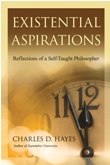
Existential Aspirations: Reflections of a
Self-Taught Philosopher is
available at Amazon, the release date is September 1st 2010.
Click here to pre-order from Barnes & Noble
Click here to pre-order from Borders

Deliver Us from
Ignorance: Freedom’s Higher Meaning
© Charles D. Hayes
First, the bad news: Throughout history a
succession of serious philosophers have reminded us that life is a
dead-end journey in which everything good is fleeting. A trajectory of
entropy ensures that the elation we experience in life is really an
illusion, and that time will ultimately cure us of this fantasy. It’s
pessimistic and sad but technically irrefutable. We are all going to
die—sooner than most of us would like to admit—and someday, without
fail, everything we have created will perish without a trace.
Existential psychology reveals that many of us use
the concept of freedom as a distraction from the dread of oblivion.
This preoccupation is so wrapped up with our sense of identity that
parsing the two can be difficult. The good news is that if we can
simply come to grips with the bad news without blaming others for our
existential anxiety, then facing this poignant certainty can add
direction and greater meaning to our lives.
Think of it this way: Near the center of human
concern is a black hole of negativity, and the inevitability of
nonexistence is at its core. Only through awareness, existential
honesty, and good will can we keep this insatiable force from draining
away our humanity. As we age, the black hole’s gravity pulls us ever
nearer, while the most fearful among us tend to react by trying to
change the subject or lashing out at others.
Physicists tell us that the most omnipresent
material in the universe is something we can’t even see: dark matter.
We don’t even know what it does, although there’s a possibility that
it holds everything together. In society, we also have something that
functions as a universal backdrop. Society’s dark matter is an
emotional background of angst and aspiration. It’s both ill will and
good will. We can’t see it, but we all know it’s there; it’s
everywhere. Anxiety and aspiration are like matter and antimatter. The
anxiety emits cultural bias, a strain of attitude, that forms a milieu
of invisible but projected contempt and prejudice which is felt as
stigma by those targeted. The aspiration is the force of creativity
found in science and the arts and spurred on by kindness, civility,
and appeals for justice and equality.
Societal dark matter ranges from the noble
aspirations of the humanities to malignancies of genocidal hatred—it
can bring us together or tear us apart. Considering what research in
psychology has revealed about human behavior, we should be willing to
allow for the possibility that society’s dark-matter angst is, to some
extent, misspent anxiety—a rejoinder against life’s brevity. Better to
align with the aspirational forces, in hopeful efforts not only to
make the best of the time we have, but also to be grateful for having
had the opportunity.
The certitude of impending death has a
psychologically distressing effect on us, both consciously and
subconsciously. Unfortunately, the angst that naturally follows can
lead to war. Too many lives are cut short because we lack
understanding about freedom’s association with our sense of identity.
What is your definition of freedom? If a person is
free to go anywhere, for any reason, at any time, but can’t earn
enough money to rise above abject poverty, is that person really free?
In underdeveloped countries, are people who live in trash heaps free?
After all, as is often said in
America, anyone has the right to
sleep under a bridge, the rich included, although the rich seldom take
advantage of the opportunity. If people can’t quit their low-paying
jobs for fear of losing their health insurance, are they free? What
about individuals who are so inhibited by what others might think of
them they never do anything they really want to do, but instead
restrict their life choices to only those acts that they believe will
gain them social approval? Are such people really free? How about the
groups with which we identify—have you ever considered how they might
influence our idea of freedom?
There is a mountain of research to support the
notion that our respective cultures serve as psychological safe
havens, sheltering us from existential angst and anxiety. As soon as
we come to realize that our parents are not omnipotent and cannot save
us from the inevitability of nonexistence, we begin to invest our
psychological good will in our culture and especially the groups we
associate with. Geography shapes our views by shaping our language,
evidence the differences in geographical dialect. We seem to know
intuitively that the groups we associate with will serve both as
distractions and shelters from the distress that is sure to come from
facing life’s chaotic complexities.
The inevitability of oblivion can’t be changed, so
the mistaken but seemingly most comforting thing to do about it is to
change the subject. Counterintuitive as it seems, however, confronting
death has been shown to greatly enhance one’s appreciation for life.
Nevertheless, even if we know this, we invest so much of ourselves in
our culture that it becomes a big part of our identity. We are
temporary, whereas our culture can go on for centuries. Consequently,
we can become so wrapped up in our factional uniqueness that when our
group identity is threatened, we take the threat personally.
For us to die as individuals is one thing, but it’s
quite another for our kind to cease to exist. This existential
sensibility is often expressed as threats to one’s freedom, but more
often than not, it’s not about freedom at all—it’s about
otherness masquerading as an obstacle to freedom. It’s almost as if
the very fact of another’s existence keeps one from being free to be
oneself. Think, for example, of all of the instances of homophobic
individuals we’ve heard complaining about having homosexuality “in
their face,” so to speak. The experience is frightening to them
because overt otherness is
related to change; psychologically, otherness turns out to be death’s
cousin.
Moreover, the presence of what seem to be extreme
cultural differences presupposes the possibility that one’s beliefs,
customs, and most cherished ideals could be wrong. For most of us,
this possibility is consciously disturbing, but for some, it’s
subconsciously terrifying. The prospect of reaching adulthood,
especially the fall and winter of life, and discovering suddenly that
one’s foundational assumptions about the world are egregiously in
error may be one of the most psychologically threatening things that
can happen to a person. For someone who harbors deep emotional fears
about the certitude of nonexistence, such a discovery could mean
having to admit that one’s whole life amounts to little more than a
mistake. The common reaction is to dig in and stand one’s ideological
ground.
Our metaphor that blood is thicker than water is a
truism, but many other kinds of associations can also trump our moral
ideas about right and wrong. It’s not uncommon that we forgive our
group members for most of their transgressions and hold those of our
enemies against them for eternity. Any group who perceives their
identity is under attack experiences feelings of being marginalized
(and marginalization is metaphorically akin to death by degree),
whether they are young, old, male, female, black, white, liberal,
conservative, or any other defining distinction. If one’s sense of
identity is diminished in any way, the effect is a subtle reminder of
demise.
My point is profoundly important but seldom
acknowledged publicly: at the heart of human anxiety about the essence
of freedom is the reality that we can never be
free of the thing we fear most—death. Clinging to beliefs and to
one’s group identity may offer temporary solace, but ultimately it is
not a satisfying refuge. On the contrary, it exacerbates fear while it
spawns contempt as a defensive reflex. Further, the psychological
conflict resulting from a diverse range of opinions and feelings about
religious faith within our culture ratchets up group animosity to the
level where it becomes commonplace for individuals to give voice to
expressions of hatred in public; rage masks real fears, and contempt
serves as a bonding mechanism for intensifying group affiliation.
Today’s Tea Partiers are a conspicuous assemblage
incurring serious existential angst over their tenuous grip on their
sense of identity. A New York
Times poll recently suggested that those who self-identify as Tea
Partiers earn more than most people do on average and that they are
better educated. I can believe the former but not the latter. Better
educated by what standard and by whose measurement? Mind you, this was
a poll, so I wouldn’t expect people unaware of their ignorance to do
anything other than exaggerate their level of education. Tea Partiers
are anxious about their sense of identity
and their economic security,
and they have good reason for worry about the second point.
The purposeful middle class enabled by progressive
tax policies both before and immediately after World War II has been
eviscerated by special interests and by the Republican Party in
particular. Whereas a half-century ago almost any “white” adult male
could get a full-time job and earn enough money to support a family,
today even an advanced technical education guarantees neither
employment nor a living wage. Many white- and blue-
collar communities have been ravaged by home foreclosures,
unemployment, and factory shutdowns, while crime is rampant and
fear-mongering politicians increasingly point to
others as the cause of this
misfortune.
Illegal immigrants catch the brunt of this
dark-matter animosity, while the fearful among us ignore the
prosperity we enjoy from their back-breaking efforts in America’s farms, factories, and
fields, performing jobs shunned by the general public. Hispanic
immigrants are only the latest to garner such attention. Throughout
American history there has never been a shortage of out-groups to
absorb contempt-driven wrath for their overt otherness; they pose an
existential threat in the minds of the general populace. In
Arizona, for example, the crime rate has
dropped appreciably in recent years, while the fearful unease of the
middle class has escalated into a kind of paranoia, proportionately
out of touch with the current reality. In the meantime, the political
power to be gained by politicians in fanning the flames of public
sentiment is so great that there is little chance for achieving a
reasonable solution to the problem of illegal immigration.
Lots of people are deeply worried because the
president of the United States is of mixed race. He’s
perceived by many as being a foreigner. He’s not of their group, and
he speaks constantly of change. Even the fact that he is an eloquent
speaker is used as evidence that he is not a regular guy, but is
instead an elitist and a liberal to boot. People who can’t relate to
him consider his presidency illegitimate, and hence the incessant
complaints by those who have come to be known as birthers.
A significant number of people who call themselves
Tea Partiers may earn above-average incomes and they may be
technically literate in their career fields, but they are egregiously
ignorant of the knowledge that serves as our aspirational guide toward
civilization and helps us to mitigate our worst instincts. Tea
Partiers see their way of life as coming apart at the seams, and they
are desperate to simplify their predicament by finding someone to
blame. They claim to want to put things right again and thus regain
their freedom or “take back our country,” as they often describe it.
This freedom, however, is not so much to do as they please as to not
be reminded of their existential fears by the overt presence of othernesss. Tea Party pronouncements of what must be done to set the
ship of state afloat show utter disregard for the conditions that find
us run aground in deficit spending. They tout remedies that bear no
relation to a realistic approach for solving our current problems
without throwing the country into a severe economic depression worse
than the 1930s.
Listen closely as Sarah Palin stands before a crowd
and asks, “Do you love your freedom?” and it’s easy to discern that
it’s not freedom but identity
she’s talking about. Freedom, as Timothy Ferris explains in
The Science of Liberty, is a product of
liberalism. He says, “Liberalism is inherently nonpartisan: It means
freedom for all, or it means nothing at all. It maintains that
everyone benefits from everyone’s freedom, and that all are diminished
whenever one individual or group is not free.” But this is not how
Palin characterizes freedom. Practically everything she has to say
about the subject is couched in dogmatic terms. Her rhetoric is all
us and
them, and liberalism—or the
freedom to do other than her group advocates— is precisely what she
decries. Railing against mandatory health insurance is not about the
freedom to go without coverage; it’s about a surplus of social
contempt aimed at people who are thought not to deserve health care
because of their beliefs and moral shortcomings.
America is suffering an anemic economy, high
unemployment, underemployment, skyrocketing debt, the threat of
fanatical terrorists, and the effects of global warming, and yet, our
undoing is more likely to come from ignorance or perhaps, more
specifically, from a sad misunderstanding about the essence of
personal identity and how our existential fears get tangled up with
the notion of freedom. In other words, we may self-destruct because of
spite. We are drowning in
misinformation, and the shrillness of Palin’s voice serves as a
metaphor for an identity-based politics that is blind to reasoned
negotiation in favor of an in-group ethos that says, “If you are not
one of us, then it doesn’t matter what you do, or what you say,
because we are right by nature of who we are.”
One can’t reason with Palin supporters because they
believe themselves to be locked into an emotional battle of
good and
evil, and those who do not
belong to their group have no legitimate platform from which to
present an argument. If you belong to Palin’s constituency you can say
or do anything with impunity, as she so often demonstrates. If you
don’t belong, however, then you can do nothing right, regardless of
the circumstances or the nature of your argument or contribution.
There is no way to say this with decorum: Tea Party
politics, to a significant degree, are driven by ignorance dressed up
as patriotism and nonsense about preserving the Constitution. At the
same time, as I’ve already said, it’s not as if the Tea Party’s
arguments have no validity. There are clearly a lot of things to be
upset about. But the current shrill rhetoric of public ire is being
orchestrated by political ideologues and media pundits, who depend on
public outrage for audience share—a situation that’s antithetical to
the sound judgment needed to sustain democracy.
Tea Party mania is not
about freedom, it’s about not being able to relate to the president
personally. Barack Obama’s presidency is thought to be illegitimate,
just as George W. Bush’s presidency was by people who could not relate
to him. And all one has to do to affirm this assertion is let the
majority of Tea Partiers explain themselves and prove for certain that
they suffer from a MRSA-like form of ignorance. There is nothing new
in the problems they complain about. The previous Bush administration
brought us to the very edge of the economic abyss, and the Tea
activists have been way late in paying attention and speaking up. But
not for their inattention to the matters they are now up in arms
about, we wouldn’t be in such a mess. By and large, the Tea Party
movement to take the country
back is not about freedom or the Constitution; it’s about
identity and the existential
angst that comes with the territory of human
mortality.
Only a quarter of our population is college
educated. Of this quarter, many are well educated in the technical
discipline of their chosen career field, but they are fundamentally
uninformed of the many aspects of the humanities that function to keep
us above the fray of political pettiness and moral collapse. We don’t
rely on the humanities for our personal sense of morality; that’s
something science reveals may be inborn and partly due to our
upbringing. But in a broader sense, the humanities keep our nation’s
“eyes on the prize,” so to speak, and help us resolve complex moral
issues. The humanities represent a guide to a just society as
expressed aspirationally in the Declaration of Independence, our
Constitution, and the Bill of Rights. When contempt born of petty
politics becomes the dominant consciousness of the day, we desperately
need the wisdom of the ages, and we need to keep our eyes and our
thoughts on those things that appeal to our better nature. In other
words, we need the guidance of the wisest among us, both living and
dead.
In my forthcoming book,
Existential Aspirations:
Reflections of a Self-Taught Philosopher, I propose that
what we need desperately as a culture is an existential education. The
humanities cannot be considered elective educational subjects unless
we set out to be inhuman. This is not, however, just an American
problem. In advocating a Socratic method of education in
Not for Profit: Why Democracy Needs the Humanities,
Martha Nussbaum writes, “Democracies all over the world are
undervaluing, and consequently neglecting, skills that we all badly
need to keep democracies vital, respectful, and accountable.” Indeed,
how do we do this if we can’t even be realistic about the source of
our own existential anxieties?
A noteworthy number of our citizens have always
maintained an anti-intellectual life stance, disparaging the need to
learn more about very things that make our lives possible. My own
father, when he was alive, would have stomped off cursing under his
breath at the mere mention of the word
intellect or
intellectual in any
sentence, no matter how it was used. I grew up under a veil of
ignorance as part of a southern anti-intellectual culture, and I know
firsthand how psychologically debilitating it can be. But these days,
in light of what recent research in psychology and neurology reveals
about our political behavior, ranting about one’s political opposition
as being the incarnation of evil is like trying to pursue vacuum-tube
computing in the age of digital formatting. That so little is known by
the public at large about issues so crucial to understanding human
relations is disappointing beyond expression.
In an earlier essay about Tea Party political
angst, I quoted Shankar Vedantam in his fascinating book,
The Hidden Brain, where he argues that
beneath human consciousness resides an “unconscious bias” whose job is
to enable us to “leap to conclusions.” This may well be the
understatement of the decade. How else can we explain the fact that so
many of our citizens argue passionately about subjects they clearly
know nothing about? Worse, how can a person attend four years of
college and escape an education, as Palin clearly demonstrates? She is
not inhibited by her lack of knowledge; to the contrary, she is driven
by it, proud of it even. As the saying goes, “the fewer the facts, the
stronger the opinion.” But where does the arrogance come from that
causes people to rant about subjects that they have knowledge of only
through hearsay, Internet gossip, and Rush Limbaugh dittos? What
causes systemically oppressed people to associate their economically
downward trajectory with a lack of freedom instead of the
sleight-of-hand, special-interest-lobby manipulation that is likely
the cause?
We don’t need extensive formal education to tell us
that things are not as they appear. We experience this daily. Most
everything we take the time to look into turns out to surprise us. And
yet, there are hundreds, thousands, even millions of sign-carrying
protestors who, when asked a few questions, will reveal that they
clearly do not understand the complexity of the issue they are
protesting about. Worse still, they will repeatedly and without fail
bite at the stick instead of the hand that holds it. They will point
fingers at people even more economically marginalized than themselves
as being the problem for their plight instead of at the people with
string-pulling power over the economy.
We do know that hatred feeds off its own misspent
surplus of angst, which is itself fueled by ignorance. But how is it
possible to continue living this way when there is so much evidence
demonstrating how destructive it is to invest hate- filled emotion
into political conflict, call it democracy, and then argue incessantly
about things without seriously studying them? Why do we scramble to
run a democracy fueled mostly by contempt instead of our higher
aspirations?
For some levity, I picked up
Idiot America by Charles P. Pierce and
Deer Hunting with Jesus by Joe Bageant. The
books are both humorous and serious about the malignant nature of
ignorance. Pierce says the rise of idiot
America
amounts to a war on expertise and claims America is the best country in the
world for crackpots and public cranks, in part because our country was
founded on untested ideas. No argument from me. But I would point out,
as many others have, that it takes a lot more effort and ingenuity to
maintain a democracy than to start one, and we are coming up short on
intellectual effort to do so. Pierce says, “Anything can be true if
someone says it loudly enough,” and that it’s common for people to
infer that fervent belief is proof of truth. Sarah Palin is an
archetype of this phenomenon.
Pierce argues that the terrorist acts of September
11 have acted as an accelerant for public lunacy, from the
X—Files to the “torture porn” by Kiefer Sutherland’s character on
television’s 24 series. He
reminds us that
America
“was founded by people who considered self-government no less a
science than botany.” And yet, these days we find placard-wielding Tea
Partiers who can’t name the three branches of government, who don’t
know that Medicare is a government program, and who think President
Obama is going to take away their guns and put a stop to sport fishing
in America.
The hilarity of Joe Bageant’s
Deer Hunting with Jesus is offset by its
deeper message about the utterly debilitating, destructive nature of
ignorance. Bageant’s book is centered on his hometown of Winchester, Virginia,
a place he characterizes as fast becoming the bedrock of a permanent
underclass. He tells us that our country is three-quarters working
class but that most of us are conditioned not to think of ourselves as
such. With a flair for making the issue of class ring out, Bageant
writes, “If your high-school-dropout daddy busted his ass for small
bucks and never read a book and your mama was a waitress, chances are
you are not going to grow up to be president of the United States,
regardless of what your teacher told you.” From here he gets into the
mud and the blood and the beer and the sheer hopelessness of so many
uneducated but well-meaning people locked into a merciless feedback
loop of lashing out about the wrong things for the wrong reasons. A
self-described lefty agitator, Bageant was writing about the angst
that fuels Tea Party sentiment long before there was a Tea Party. He
identifies the time-worn but dependable tools of the political right:
propaganda, ignorance, fear, and emotion as a substitute for thought.
If you really want to understand
our current
knowledge deficit, I highly recommend Susan Jacoby’s book,
The Age of American Unreason. Jacoby puts our
predicament in historical perspective. She characterizes the early
nineteenth-century lyceum movement through the early 1960s as a
culture of aspiration. But today, Jacoby points out, we increasingly
find ourselves in a culture ill with a “mutant strain of intertwined
ignorance, anti-rationalism and anti-intellectualism” where
un-mindfulness is promoted by politicians and media executives who
depend upon non-thinking voters and vacuous sound bites.
In his essay “Compensation,” Ralph Waldo Emerson
reminds us that, contrary to popular belief, we do experience justice
in this world—and not the next—through the simple rules of cause and
effect. “Every sweet hath its sour,” he says, and elsewhere, “All
infractions of love and equity in our social relations are speedily
punished. They are punished by fear.” Finally, “A man cannot speak but
he judges himself.” Carry around nonsensical signs that ring of hatred
if you must, but first try hard to figure out what they really mean
and what you are really afraid of. If you don’t, the injury will be to
yourself.
In their book
The Spirit Level: Why Greater Equality Makes Societies
Stronger, Richard Wilkinson and Kate Pickett offer
thirty years of well-documented research removing all doubt that
growing inequality leads to contempt on steroids. In other words,
inequality results in an exponential increase in the range of angst in
our cultural dark matter. They write, “The problems in rich countries
are not caused by the society not being rich enough (or even by being
too rich) but by the scale of material differences between people
within each society being too big. What matters is where we stand in
relation to others in our own society.” To which I will add that a
failure to understand how our unconscious fears lead us to disdain
otherness is an existential booby trap and an emotional cul-de-sac
that often results in social catastrophe.
Socrates declared that “the unexamined life is not
worth living.” I have always thought he overstated the case. But if he
had made an equal argument about the need for exploring the fears born
of our mortality, then there would be no objection from me. Had he
done so, he might have saved countless numbers of people from an early
death by enabling them to come to terms with their own existential
angst, instead of attempting to take it out on
others. Of course, Socrates
was disadvantaged. He knew the human race is heavily populated with
fools, but he didn’t know that our bicameral minds, with their
split-brain architecture, enable us to park our fears in one
hemisphere with only a vague awareness of it in the other. This
arrangement sets us up with a pattern-matching capability to make
inferences that will allow us to mask our real concerns by focusing on
small problems as substitutes for big ones, and the process haunts us
with smoldering anxiety.
In the final analysis, the notion of freedom will
always be tainted by the reality that there are some fears that we can
never fully free ourselves
of, and that we need desperately to learn to live without avoiding our
fears through the seductiveness of distraction, diversion, and
targeted blame. Emerson said, “All things are moral.” He also reminds
us that no view of life is valid if it omits life’s harshness. Indeed,
in spite of centuries of avoiding the subject of mortality, embracing
it head-on is a shortcut to experiencing freedom as an aspiration of
authenticity and an acknowledgment that genuine freedom is experienced
in a life free of the angst of ignorance and the bias and pettiness of
contempt. By all means let’s get on with a Tea Party political
discussion, but first put down your nonsensical signs and do your
homework.
Having spent my formative years in the grip of a
regional ideological illusion, I can relate to George Bernard Shaw’s
illuminating line from Caesar
and Cleopatra, “Pardon him, Theodotus: he is a barbarian, and
thinks that the customs of his tribe and island are the laws of
nature.” It takes a sustained intellectual effort to get beyond the
self-justifying parochial worldviews we internalize growing up. But
until we do, we can make no claims on having understood the concept of
freedom or the psychological fears that, without our awareness, can
serve as little more than a refuge of ignorance and as bastions of
contempt.
The subject of freedom
deserves serious study in its own right, but for starters it should
not be confused with the notion of identity and as an escape from the
existential reality that is part and parcel of being mortal. So, I
suspect that if Shaw were here nowadays to hear Sarah Palin ask an
audience if they love their freedom, he would say, “Pardon her,
Theodotus, for she is from Wasilla.” But then, what can I say? So am
I.
September University: Summoning Passion for an Unfinished Life
is
available from Amazon at discount. Click on the title.
Click here to order from Borders Books
Click here to order from Barnes&Noble
Charles' forthcoming book
Existential Aspirations: Reflections of a
Self-Taught Philosopher is
available for
pre-order at Amazon, the release date is September 1st 2010.
Click here to pre-order from Barnes & Noble
Click here to pre-order from Borders

Coffee Time: Reason,
Bigotry, and Tea Party Angst
©
Charles D. Hayes
Remember the movie
Cool Hand Luke,
where the prison warden
tells Paul Newman and his fellow prisoners, “What we’ve got here is
a failure to communicate”? Well, I’m going to go out on a
politically incorrect limb and argue that when it comes to the Tea
Party movement, what we have here is a failure to
keep up with current knowledge about
human behavior—especially when it comes to politics. It’s time to
introduce some fresh, strong coffee where tea is being served.
During the past two
decades, a groundswell of research in psychology and neuroscience
has begun to turn our long-held views about human character on their
head. In 1999, in a groundbreaking book titled
Philosophy in the Flesh,
George Lakoff and Mark Johnson put it like this: “We’re not who we
thought we were. What we do is not what we thought we were doing.”
But if that’s the case, then who are we? Keep this question in mind
as you read.
Unfortunately the
aggregate of innovative research has yet to become conventional
wisdom, but it is rapidly approaching a critical mass that, in my
view, will someday
result in a paradigm shift in the
way we think about human character and the whole concept of virtue
and morality. Lakoff and Johnson explain that reason is not a
disembodied experience as it seems, but is instead shaped by the
body. For a telling example, a University of Amsterdam study
revealed that people are apt to lean forward when thinking about the
future and lean backward when thinking about the past. Reason, as
Lakoff and Johnson make clear, is largely an unconscious function
that arises from bodily experience. It is not at all dispassionate,
but is instead emotionally engaged; it does not use a literal
methodology of discerning truth but rather relies on metaphor.
We understand one thing
from having understood another, imprecisely, so to speak. It turns
out that emotion is an essential ingredient of reasoning. For an
analogy, consider that a two-cycle chainsaw engine requires a
precise mixture of both oil and gasoline to operate. Similarly,
humans require a precise mixture of reason and emotion to function
well, and yet we depend upon, and in fact routinely operate with,
wildly different mixture ratios of the kind that could ruin a good
chainsaw.
Since the period known as the Enlightenment, we
Homo sapiens have, for the most part, imagined ourselves to be
reasonable, rational creatures, who assess situations analytically,
think computationally, and act pragmatically. Moreover, we were
taught to believe that our character as individuals is like a
container of virtues whose integrity depends on those virtues being
used consistently. This is how most of us were raised to think of
ourselves and others. Current research, however, shows that when we
actually examine the way we behave, this view is nonsense. We are
far more influenced by emotions than we ever imagined possible, and
we often mistake strong emotion for reason simply because it feels
so right and so urgent that we do so. It turns out that the
consistency of our penchant for virtuous behavior depends far more
on the context of the circumstances at hand than any other
consideration.
In
Experiments in Ethics,
for example, philosopher Kwame Anthony Appiah writes about how
seminary students who were told they were running late were much
less likely to stop and aid someone in actual need of a Good
Samaritan. He cites experiments where individuals are more likely to
get change for a dollar from strangers if they ask for it standing
outside of a bakery with fragrant aromas. People who dropped papers
outside a phone booth were more likely to get help picking them up
if the person in a position to help had just found a coin left by
someone in the coin slot. Elsewhere I’ve read studies showing that
judges in criminal court will impose stricter sentences if they are
in some way reminded of their own impending death while they are
deliberating; they are more likely to be persuaded to go with the
majority if they are on a panel of judges. Recent research at Yale
suggests that the temperature of our coffee can influence our
estimations about the personal warmth of individuals. Studies at
Stanford University,
meanwhile, show that African Americans with stereotypically darker
than average skin color are more than twice as likely to receive the
death penalty in capital murder cases.
During the past decade
we’ve seen too many examples of this kind of behavioral experiment
to list. Some seem silly, but the lessons are both simple and
profound: change the context, gender, or race of the individuals
involved, and you can expect changes in behavior that defy our
ideals about possessing and applying virtue and unbiased judgment.
It’s disturbing that changes in context can be so banal and still be
relevant. Knowing that when circumstances are contrived and slightly
altered our behavior is largely predictable is at best
disappointing. The evidence suggests that we are much more reflexive
than reflective when it comes to morality, and this in turn means
that most of the discussions we have about human character are
unproductive. In other words, we have been arguing for generations
about a subject we haven’t understood well enough to discuss
intelligently.
Likewise, we have been
taught to deplore bias, unaware that it’s a survival mechanism.
Without our propensity for bias, our species would very likely have
perished long ago. We need to understand how bias works to have any
hope of addressing it rationally. In America
these days, we find it disturbing when little boys and girls of any
race are given pictures of black faces and white faces and
subsequently show a preference for the white faces, associating them
with more positive attributes than the black faces. Yes, this is
disturbing, but it is also extremely instructive. What brain science
reveals is that our pattern-matching brains are ever on the alert
for pegging reality for the sake of our continued well-being.
We are equipped with an
unconscious cerebral feature that acts sort of like our personal
accountant; it’s a reality checker, so to speak. The accountant
takes in lots of information, everything really, and keeps a hard
tally, albeit one that exists in large part beneath consciousness.
This part of our gray matter is what Shankar Vedantam describes in
his fascinating book
The Hidden Brain,
as an “unconscious bias” whose job is to enable us to “leap to
conclusions.” If most of the people one sees on television are
white, and most of the people in power are white too, then the
accountant knows that this is the case. She takes in everything, but
she keeps quiet about it, until a situation arises that requires an
intuitive nudge. It’s her job to look out for us. Her conscious
counterpart is politically biased left or right, to be sure, and her
take on realty is dependent upon a complex set of spatially
entangled metaphors that Lakoff and Johnson describe brilliantly.
But it’s also her job to see that we are not surprised by situations
that will find us unable to act in accordance with the way things
actually are, instead of as we wish the world to be. Thus, the
underlying urge to conform sometimes overpowers what we consciously
understand is the right thing to do.
Not only does our
accountant notice the big things that occur around us, she also is
hypervigilant for the subtle looks and expressions that betray what
others are really feeling but are not saying. She senses the bias in
others with astounding perceptual ability, but she usually keeps
what she learns to herself. She’ll speak to us of it only when she
thinks it’s necessary, not in words, but in intuitive feelings or in
dispositional nudges that tend to feel very much like common sense.
The evidence that we are so heavily influenced by many things we’re
unaware of is everywhere, says Vedantam, and society pays an
enormous price for our inattention to matters of such great
importance.
The deep diligence of personal accountants at
large in a society that’s far out of kilter in terms of economic
inequality is why affirmative action is still necessary to bring
about levels of equity that do not reflect advantages for one race
over another. Until the reality of bias negatively affecting African
Americans and other minorities ceases to exist, something has to be
done to keep the unconscious accountant from forcing the reality of
conditions into alignment with the way she perceives they are
supposed to be. She’s not mad at anybody; she’s just doing her job
in accordance with her wiring. She will act when she thinks she
needs to by metaphorically kicking a decision maker under the table,
steering someone toward the resume of the white applicant, for
example, without letting on to the person’s conscious mind that that
is indeed what is happening. She is so good at this sort of thing
that we will rarely ever need to consciously acknowledge the piece
of data, no matter how flimsy or insignificant it might be, that she
brings to our mind to provide a convincing rationale for showing
racial preference. Vedantam says, “The hidden brain is insidious not
because it whacks us on the back of the head but because it places
the tiniest of fingers on our inner scales.”
In spite of the fact that this unconscious but
consistent discrimination is statistically provable beyond doubt,
it’s very nearly impossible to get the people doing the
discriminating to believe that they are, indeed, guilty of it. No
real malice is necessarily involved in this kind of discrimination.
Declarations that one is unbiased are more often than not sincerely
felt, but they come from people generally unaware that they have an
unconscious accountant working 24/7 on their behalf. That’s how our
brains help to ensure our survival; it’s the software that comes
with the hardware of experience, programmed through thousands of
generations when the times were often met by plague and scarcity,
and when differences represented the cutoff point for dividing
bounty. For millennia, differences raised suspicion, and our
still-active but primitive detection apparatus is expert at
discerning them.
There is much discussion
about celebrating our differences, but I will argue that most of our
subconscious accountants don’t buy it, even when we think that
we do, especially when resources of
any kind become scarce or hard to come by. As notable differences
increase exponentially, our hostilities escalate over the
possibility of having to share our largesse with those who we are
inclined to suspect don’t deserve it because they are not in
our
group. And while we may not
consciously seem to care much about these kinds of issues, our
accountants, under the right conditions, are prepared to make a big
fuss about it through skyrocketing anxiety, especially if we are
goaded by members of our own group to fear that we are not getting
our share of whatever it is that is to be had.
Up to now I have been
addressing the issue of racial bias as an unconscious artifact, as
something that Americans are trying to get beyond. But there is
another aspect of bias in which the “tiniest of fingers on our inner
scales” won’t apply. This is consciousness: the flip side of the
unconscious mind and what we generally refer to as conviction. When
strong conviction takes the place of reason, it can easily turn
politics into hatred. To be effective and just, political discourse
requires affection for and an adherence to the better argument, but
when the engagement is emotionally driven, it defaults easily into
baseless assertions and goes downhill from there.
Conviction and expectation
frequently switch roles, fueling and warping judgment by upping the
ante of sentiment, and overriding one’s ability to reason. Moreover,
if the conviction is powerful enough, it’s likely that the conscious
and unconscious minds will be united in agreement; hatred relies on
both. Not many years ago, for example, there existed a cultural bias
so ubiquitous and so powerful that most homosexuals were homophobic.
What does this tell us? Our culturally learned expectations can be
so dominant in influencing us that, in effect, we see what we expect
to see, taste what we expect to taste, and feel what we expect to
feel. In his book
How We Decide,
Jonah Lehrer explains that this sense of anticipation is what drives
the placebo effect. Further still, it’s what turns abused children
into child abusers.
I grew up in Oklahoma and
Texas during the 1940s and ’50s, a time when my metaphor of
unconscious accountants appears pathetically naive. Make no mistake,
there are still deep pockets in the
United States
where overt racism is alive and well and where there need be no
pretentiousness about whether bias is conscious or subconscious.
Moreover, as Michelle Alexander’s research shows in her book
The New Jim Crow,
many of our claims about overcoming racism are more apparent than
real because correctional department statistics tell us otherwise.
Fortunately, though, many
of us have set our unconscious accounts straight about racial
injustice and lingering inequality. I know from personal experience
that this is possible with hard work and rigorous thought, but it’s
nearly impossible without serious introspection and a bold look at
the reality of the way we act, not how we think we act, with regard
to perceptions of
otherness. In
other words, we must remain alert. Vedantam puts it this way: “If
the conscious mind is the pilot and the hidden brain is the
autopilot on a plane, the pilot can always overrule the autopilot,
except when the pilot is not paying attention.”
Now, the fact that we have noble theories,
expectations, and aspirations about human character is not a bad
thing. In fact, more than being an admirable trait, it’s also
something we must aim to achieve with greater success in the future.
But, unless and until we fully understand the theories about how our
actual behavior does or does not square with what we say, we have
little chance of living up to our ideals. We need to recognize how
changes in context affect our decision-making processes. We need to
fully understand and appreciate the differences between reasoning
and relating.
When we relate to another
person, we achieve a bond of association that may in the future be
considered more important than any other issue that tries to get in
the way. In the context of disagreements about political matters, I
use the term
relating to
describe how those engaged in the argument deflect opposing ideas
from others by aligning with the views of their own respective group
as a distraction. Reasoning, a more rational faculty, is
computational but also something we feel viscerally. Reasoning can
quickly turn into a posture of relating, however, when our
hot-button emotions are triggered.
When this happens, we shift from
thinking with our critical reasoning abilities to an overwhelming
experience of feeling wherein our group identity stands in for our
reasoning processes, and a flood of emotion acts as a protector or
defender of our identity. This cripples our ability to negotiate
political differences objectively because it so often occurs without
our awareness and it keeps us from listening to any views except our
own. Simply put, embodied reason, because it is embodied, can, when
push comes to shove, morph into relating, and if we are not
hyperaware of this tendency, we cannot guard against it.
The premise of reasoning
versus relating is easier to understand when you realize that there
is also a physical component to relating. Think back to the last
time you were in a group meeting and you noticed people sitting
around the table mimicking one another’s body language. Reasoning
and relating would seem to be two extremes of one process that can
turn instantly into becoming one or the other with the swiftness of
an on/off switch.
We need to fully realize
how our inherent tendencies for tribal
relating
are exacerbated by our idealized aspirations for democracy, because
sharing power through reasoned mediation goes against the grain of
our behavioral inclinations. These conflicting forces are further
complicated by the fact that very successful celebrities, ministers,
and politicians have the kind of charisma that inspires
relating
over reasoning; they are continuously stirring the pot of public
opinion, often simply to gain their own personal advantage.
Relating in and of itself
is not something to avoid. This is, after all, in large part, the
biological software that enables us to bond and form family and
kin-like associations. The dangerous aspect of relating, however, is
when it becomes a complete substitute for
thought.
Unfortunately, this happens easily
and often, and when it does, it robs democracy of the very reasoning
ability democracy requires to sustain itself. Democracy depends upon
accepting
the better argument; it cannot be
sustained when driven by baseless assertions and accusations, or it
will ultimately lead to fascism. Further, the phenomenon of relating
explains why there are so many people among us who think themselves
exempt from the rules that the rest of us are required to follow;
they become accustomed to being related to instead of being held
accountable for their shortcomings. The result is arrogance. The
fact that Ronald Reagan was often referred to as the Teflon
president was precisely because so many people identified with him.
Relating instead of
reasoning is something neuroscience shows that we do when we
encounter hot-button political issues and the discussion gets out of
hand
emotionally. Reasoning speaks for
itself only if we realize how fragile it can be and how easily it
can turn into relating. But when we
relate,
in effect, we deflect arguments counter to our own or ignore them
altogether with a flood of emotion that feels exactly like reason
because it is so powerful. Then we offer a passionate emotional
response that is more of a reaction than an argument. When we relate
to others politically, it’s not a stretch to say that we experience
both a conscious and often deeply subconscious connection to them;
it’s as though we view them as literally being one of us or, in the
primeval sense, in our tribe. It’s as if our internal but
unconscious accountants agree about the nature of reality. We’re
bias buddies, so to speak.
When both religion and
politics are shared among individuals, the connection deepens even
further. Brain scans reveal that we humans relate to the idea of God
precisely as we would to another individual, which has profound
implications for society at large that beg further psychological
exploration. Thus, relating is a very complex issue, but it is not
so complicated that we can’t benefit from a better understanding of
our predispositions for human relations. Say what you will about my
brother, he is still my brother. The same kind of connected
affiliation applies to members of the groups with which we identify,
usually, but not always,
to a lesser degree of attachment
than with a sibling or family member. In any case, relating is
relating is relating.
Perhaps it’s partly because I live in Wasilla,
Alaska, and partly because I’ve been an advocate for vigorous
self-education for more than two decades, that I cringe with
embarrassment when Sarah Palin spews forth Tea Party rhetoric in a
public forum. But I understand why the people who relate to her
don’t care about the accuracy, coherence, or the veracity of her
claims. She is, after all, perceived as one of them, which is why
her supporters are often oblivious to the validity of criticism of
her. Their connection is instinctive; their subconscious accountants
are soul mates, although I suspect their accountants frequently
break through and communicate directly to their conscious awareness
because strong feelings of righteousness have a way of forcing to
the surface notions of superiority over others. The racist attitude
of many Tea Partiers is readily apparent. Palin’s particular
position on this or that issue doesn’t matter much, however, because
the people who relate to her expect that in any given circumstance
she will act as they would act.
When relating takes
precedent over reasoning, democracy loses out to tribalism, and
fundamentalism of any flavor is a clear declaration of the latter.
Further, since charismatic individuals learn quickly that their
constituents will not hold them accountable because of the relating
factor, many of them self-destruct as they take their feeling of
exemption from personal responsibility too seriously. Examples
abound.
Coffee, anyone?
Both liberals and
conservatives choose relating over reasoning at times, but research
shows that conservatives place much more value on in-group loyalty
than liberals do. There is plenty of research data to back up this
assertion; one doesn’t have to resort to anecdotal evidence of flag
waving and lapel pens, although it’s hard not to notice such
behavior. The Tea activists show special concern for fiscal
responsibility, national security, personal freedom, and upholding
the Constitution. These are valid concerns. But the party is nine
years late. Hypocrisy is best served cold. Where was the outrage
when the GOP ballooned the national debt into the stratosphere
(taking pork while railing against it), when it advocated attacking
a foreign country under false pretenses, violated the Constitution
both in spirit and the letter of the law, and posed the biggest
threat to the individual freedom of American citizens in a century?
Where was the outrage when the Bush Administration let Wall Street
lobbyists write the legislation that deregulated the world of high
finance, effectively privatizing profits and socializing risk? Where
was the outrage about the breach in national security that Ron
Suskind writes about in
The One Percent Doctrine,
when in August of 2001, a CIA briefer flew to
Texas
to warn George W. Bush personally about a possible al-Qaeda attack
on America,
only to be told by a flippant Bush, “All right. You’ve covered your
ass, now.” Too bad Bush didn’t cover ours, but he didn’t have to
cover his own because the Tea Partiers of the future related to him
as one of them.
Inherent in the ethos of
over-relating is the ratcheting up of nationalism, which often
manifests in a willingness to take up arms against someone—anyone
convenient. Iraq
turned out to be convenient for Bush because it let him show loyalty
to his constituents and up the ante of bravado set by his own
father, who took Saddam Hussein on but didn’t take him out.
Now, after one year of Obama’s presidency, the
spending his administration has done in an attempt to get us out of
this mess is said by the Tea Partiers to be the road to ruin and the
end of freedom. It’s time for these folks to reach for a strong cup
of java. Lots of us across the liberal-conservative span of politics
don’t approve of the way the bailouts were handled, but we can
understand the urgency to act and the danger of not doing so. Most
of the people who would become Tea Partiers, however, gave Bush a
pass on everything that is now all of a sudden DEFCON 1 important
because they identified with him. Now that a political party is in
power that they can’t relate to, the blame for the whole mess of the
previous eight years is president Obama’s by default and with a
vengeance. Sorry, but a generous serving of fresh roast is called
for here.
I can identify with the
Tea Partiers in a way that I suspect most of you reading this piece
can’t. Three decades ago (before I began my own serious efforts of
becoming self-educated), I would very likely have been a Tea Partier
myself. I can still recall what it was like to reach adulthood
without enough knowledge to think independently and overcome the
bigotry and racism ubiquitous in the communities I grew up in. This
is why I know firsthand that Tea Partiers represent the epitome of
relating instead of reasoning.
Watching and listening to most of
them, I can see from their inability to articulate their concerns
that they rarely do their homework, as I rarely did in those days,
and that much of their anger stems from their incapacity to cope
with lives far more complex than their education has prepared them
to deal with. For critical thought they substitute what they hear
from sources that confirm their worst fears. Right-wing radio-talk
show hosts make a good living—an easy living—because it takes little
effort to attract a following by scaring people with notions of
otherness, when so many people are already fearful because of
economic stress. So, it’s not surprising to hear the Tea Partiers
described as the “mad as hell” people who are “not going to take it
anymore.”
It has been widely
reported by media pollsters that the majority of Tea Partiers think
their taxes went up during the first year of the Obama
Administration, when in reality, for 95 percent of Americans, taxes
were lowered. A frequent observation is that Tea Partiers react
negatively when their beliefs are threatened, but it’s more accurate
to suggest that their angst occurs when they fear their identity is
at risk. Their beliefs, after all, are interchangeable with their
sense of identity—that’s the essence of relating. There are indeed
some knowledgeable individuals in this group who do adhere to their
ideological principles. But, for the most part, the Tea Partiers
represent what might best be characterized as an anti-intellectual
movement made up of people with too little knowledge of the issues
that bedevil them to have any sense of objectivity about what they
are angry about. It is far easier to substitute anger for knowledge,
and there is also much to be angry about, regardless of which
political party is in power. In a very real sense, our worldviews
are like investments: the more stock we have in them, the more
defensive we become of them when they are threatened. And when
worldviews rest on baseless
foundations, there is little choice
but to substitute anger for articulation.
In his book
Going to Extremes,
Cass R. Sunstein argues that extremists can be very rational, but if
they lack the knowledge necessary to have a rational discussion, and
if what they do know is wrong, then their emotions will distort the
issues at hand beyond redemption. And thus, in such circumstances
the ill-informed rely on one another to validate what they think
they already know while their group enthusiasm intensifies their
self-induced angst.
The quality of any democracy is completely
dependent upon the education of its citizenry, and most of the Tea
Partiers have little to offer us but their rage. Moreover, to the
degree that this group is goaded and financed by special interest
organizations to act out their umbrage, this movement amounts to
orchestrated ignorance reminiscent of the Swift Boaters in the 2004
election. That we let this happen shames us all because these people
I’m calling Tea Partiers are our mothers, fathers, brothers,
sisters, cousins, aunts, uncles, and neighbors. These are the people
that in wartime we share foxholes with, without an iota of concern
about their politics.
Conservative
New York
Times columnist David Brooks
recently likened the political-right Tea Party movement to the
activism of the left in the ’60s. Sorry, but a movement to stop a
needless war is not on a parallel with angst orchestrated by fear
mongers. Brooks can be an astute observer, but he often
over-relates. In a later column called “The Emotion of Reform,”
Brooks says there is something morally impressive about the passion
of Democrats for health reform, but then he finds it interesting, if
not somewhat puzzling, that they do not have similar zeal for aiding
small business or addressing the deficit. I’m not surprised that
he’s taken aback, but I do find it
disappointing.
Healthcare is, after all, for many
people a life and death issue. And yet, practically every Sunday
morning, on shows like
This
Week and
Meet the
Press, television pundits, who
obviously don’t have problems with their own ability to afford
medical insurance, fault the Obama administration for not focusing
exclusively on creating jobs. Of course, this is all well and good,
unless
the absence of affordable healthcare
means you can’t continue to live.
The ease with which the
privileged use a stiff upper lip to dismiss millions of people
without medical insurance coverage is breathtaking. Former Reagan
speechwriter Peggy Noonan frequently gushes about this problem as if
it’s a trivial issue. She keeps making the point that the only thing
the Obama administration should be concerned with is
the economy.
That she can write so eloquently
about American ideals and yet be so dismissive of the plight of all
the citizens without health insurance is morally stupefying. There
are good reasons for people to be passionate about healthcare. It’s
an issue one can relate to and reason about at the same time without
worrying about being irrelevant or inappropriate. Passion and reason
can go together—that’s how human
beings arrived at the notion of justice to begin with. But let’s not
let reality corrupt the view. The past decade is worth another look.
In 2001, terrorists attacked the World Trade
Center, killing nearly 3,000 Americans, and we began a $3 trillion-
dollar war effort with no real end in sight. The Bush tax cuts that
followed added another trillion dollars to the deficit. Then in
2007, greedy, incompetent, and criminally negligent capitalists
dropped a couple more trillion in the subprime fiasco. Add that up
and then consider that, according to Reuters, every month more than
3,000 Americans die quietly for a lack of affordable medical
insurance. Yet when our citizens ask for help, the GOP responds by
whining that we can’t afford it. Such a rejoinder is despicable,
ethically indefensible, and egregiously un-American to anyone with
the common decency to think it through.
In one respect, however, conservatives do have a
lot to boast about. With the aid of talk radio in particular, they
have accomplished the greatest single political feat in the past
century. It’s more than a feat, it’s a coup worthy of great honors
for effectiveness, and it simply amounts to this: they’ve turned
economically marginal citizens into government haters, goading them
into being vehemently against their only real means of protecting
themselves from the abuses of a plutocracy. This is political
jujitsu, disguising an opponent’s strength, not only as a weakness
but as something to be despised. It’s relating dressed up as reason,
but without foundation.
How is it possible to hate
the very thing that your life depends on—that which our service men
and women have fought and died for—and to still act as if democracy
is something apart from and anathema to government?
America
was founded upon the idea that our rule is of, by, and for the
people, that the size of our government is less important than its
effectiveness, that to be effective it requires actively engaged
citizens who will hold government to account with more intellectual
vigor than spurious contempt. Henry David Thoreau was for small
government, but he was more about better government through superior
citizenship than he was an enemy of the system that made
America
possible. The cry for small government has become a
mindless
mantra by the same people who
advocate vociferously for the world’s largest military, without
noting the inherent oxymoronic contradiction in that objective and
notwithstanding the fact that the military-industrial complex has
become the tail that wags the dog.
Government bureaucracy is annoying precisely
because of the gap of political agreement about what government is
supposed to do. But government has no lock on bureaucracy, and it’s
easier to hold government accountable than private corporations.
Without a means of democratic intervention on their behalf,
individuals up against the power of corporations and their legions
of lobbyists are powerless. If you find this hard to believe, ask
anyone whose health insurance has been canceled for arbitrary
reasons when they needed it most.
Scaring vulnerable people
is easy, as the GOP’s recent PowerPoint presentation in Florida
demonstrates: make your constituents fearful of what you fear, and
you won’t have to deal with it. Make the public fearful of President
Obama, with posters portraying him as the Joker and a socialist, and
there is no need for the GOP’s chief financial contributors to worry
about forthcoming legislation reforming Wall Street. Scare the
public sufficiently, and the connected rich can rest easy. Thus, the
Tea Partiers bite the stick, instead of the hand that holds it.
We have some of the finest universities and
research facilities in the world, with legions of dedicated
scientists and independent scholars striving to make better sense of
human behavior. The authors cited in this essay are clear examples.
And yet, with all of this compelling data coupled with the
telecommunication technology of wizards, there is still no mechanism
in place to bring this knowledge to the forefront of our political
establishment. Would that we could use this knowledge to further our
political interests as a nation dependent upon adopting the better
argument, the better plan, regardless of who presents it, and stifle
the childish behavior we witness daily in both houses of Congress.
When we invent a better
machine, we build it and make it available to anyone who can put it
to use. But when we accumulate a mountain of data based upon volumes
of research that sheds new light on our human frailties and how our
minds really operate, we have to be completely overwhelmed and
practically drowned by it in order to take it seriously and put it
to wide use. Or, as the line from
Cool
Hand Luke might go, “What we have
here is a failure to educate.” Thus we stumble along, relating more
often than reasoning.
If one political party can
abandon reasoning in favor of relating and can effectively demonize
the other in the eyes of their constituents, then rational argument
is not even deemed necessary to resolve their differences; relating
is the only thing required. All they have to do, for example, is to
refer to the others as
liberals, which will be taken as
enough said and which lets them off the hook for further thinking.
This is politically convenient; it saves appreciable time in
examining arguments, because all one has to do to dismiss an
argument about any subject is to consider the source.
Moreover, when relating is
enmeshed deeply in intellectual political ideology, the result can
move the unconscious accountants operating among conservative
Supreme Court justices. This is what happened with the Bush v. Gore
ruling in 2000, and in the Citizens United v. Federal Election
Commission campaign finance decision of January 2010, which freed
corporations to spend unlimited funds in political campaigns under
the pretense of
free speech.
The justices appointed by George W. Bush thereby became the very
thing they said they would never be:
judicial
activists. Don’t just take my word
for this; put on a pot of Folgers and compare the actions these
Supreme Court justices took with what they are on the record as
having said in their confirmation hearings. Relating is relating,
and activism is activism, period.
There are two apparent
ways to overcome our propensity for relating and return to objective
efforts to help restore the kind of
democracy that offers a well-reasoned future. Unfortunately, the
first usually occurs when we are threatened by a common enemy, as in
all-out war. The second is far more desirable but decidedly harder
to achieve because it requires flooding our unconscious accountants
with thoughtfulness about the realities of human behavior. It calls
for us to come together as citizens who care more about the future
than we do about who is right or wrong, or about whose methodology
we use to get there. It requires politicians who care more about the
country’s future than their own political careers: the late William
Proxmire comes to mind as an example. To achieve this kind of
reasoning, we have to put relating aside, along with the detectable
and deplorable hypocrisy that comes with justifying our primitive
inclinations, and opt for the better argument.
If our current economic
situation seems hopeless, consider this: In a recent
Newsweek
article titled “Defusing the Debt Bomb,” Fareed Zakaria argues that
if we were to follow the example of more than 100 other countries
and adopt a value-added or national sales tax of 25 percent, as
others have done without slowing their economic growth, we could
balance the federal budget, pay for healthcare, cut the top tax rate
to 25 percent, and eliminate the income tax for all households
earning less than $100,000 per year, which means it would happen for
90 percent of us. The only thing standing in the way of putting the
American economy back on track to prosperity is a lack of political
backbone on the part of our representatives to demonstrate a
willingness to act like adults, stop with the scare tactics, and put
the people’s interest above their own.
Liberals and conservatives
are, generally speaking, decent people; neither side is the
incarnation of evil, as is so often argued by the other, even though
it is not undemocratic to call either side out for being wrong about
something when they are wide of the mark. Stated in the simplest
terms, the fundamental divide occurs where each side thinks the
other is concerned about the
wrong
issues and in the wrong hierarchal
order of importance. The friction
from this partition creates a surplus of disrespect that festers as
contempt. At the deepest level, it is driven and fueled by what I
characterize in
September
University
as an existential triad: fear of death, fear of the other, and a
lack of curiosity. These three issues are so interrelated that it’s
often difficult to tell which one of them is at the heart of our
angst, but they make great weapons for political strategists who
know how to use them.
Nothing we learn is going to fully close the
ideological divide between liberals and conservatives. But the time
both sides waste relating instead of reasoning, especially in our
two houses of Congress, does our system of government a great
disservice. How to settle our differences and put them in
perspective brings us back to the question posed at the beginning of
this piece: Who are we, ill-informed consumers or serious Citizens?
My own life experience tells me that we can learn
to override our inner accountants and that we should engage in
political dialog with opponents only when all sides can agree to
yield to the better argument. We are capable of becoming mindful
about how situational context influences our decisions in ways that
run contrary to our idealized notions of who we are, what we stand
for, and how we expect ourselves to behave, regardless of the
variance in circumstances we encounter. If we’re aware of our
tendency to make fickle, circumstance-dependent decisions, we can
apply an override here as well. With concentrated effort, we can
reason our way through difficult issues with our opposition, instead
of siding with our group identity and tuning the others out. If we
cannot accomplish this, we waste our time and our opportunities for
goodwill with mindless banter that does little more than up the ante
of public anxiety.
I began writing this essay long before I became
aware of the Coffee
Party Movement now being organized, but having read
about their goals and aspirations, I am encouraged. My own
scholarship began many years ago when my work schedule allowed me
enough time for serious study. In a short period of time, the
exploration became its own reward. And, as I hope this piece shows,
the most psychologically liberating discoveries to be found often
lie beyond the emotional angst of popular culture. Now that a
healthcare reform bill has passed, Tea Party and Coffee Party
aspirations could represent an opportunity to lower the rhetoric, do
our homework, and passionately reason our way to a better future.
So, what will it be for you: tea time or a coffee
klatch?
Celebrity Ego versus Democracy
(c)
Charles D. Hayes
Regardless of our personal
politics, a close reading of American history suggests that we need
both liberals and conservatives to make democracy work. Moving too
far politically in either direction is a recipe for getting the kind
of government that neither liberals nor conservatives would want.
What's not healthy for democracy is a populace that swallows whole
the opinions and convictions of prominent personalities who maintain
their status by inciting divisiveness. Democracy suffers when its
citizens vote with their emotions instead of critical thought.
To my mind, anyone who
finds the lives of celebrities more interesting than their own life
has serious issues to resolve; their education is in remission. Of
course, a casual interest in anyone whose life appears glamorous or
in some way interesting or unique is natural to human curiosity. But
to get one's daily dose of reality and political philosophy from a
celebrity--especially when that celebrity stems from an ability to
balkanize a radio or television audience, regardless of whether the
politics is left, right, or middle--is intellectually debilitating.
Stated more simply, to decide what is important, what is true, and
what one should be thinking about based upon the opinion of someone
whose livelihood depends upon their media ratings is a recipe for
high blood pressure and dysfunctional government.
In
The Rapture of Maturity, I
compared our relationship with knowledge metaphorically with
celestial bodies in space, and I warned against getting too close to
ideological black holes. At the time, I wasn't imagining such
figurative entities to be right-wing talk-radio or television hosts,
but you've only to search your AM and FM radio dial or visit the Fox
channel to confirm that they do indeed fit the description. And you
don't have to listen to these ideologues for very long to discern
that they are not the patriotic advocates of truth that they claim
to be.
Mind you, I am
not in favor of silencing vitriolic media. Both radio and television
represent an opportunity to engage citizens in public policy, and
our very way of life depends upon free speech. The current state of
talk media, however, is that of a celebrity culture made popular and
driven by aggressive efforts to instill a fear of the
other in the general
public--a fear that is often steeped in subtle but discernable
racial bigotry. Moreover, the constant ratcheting up of the
intensity of rage of and by the far-right since the election of
Barack Obama as president is demonstrable beyond doubt, with the
clear objective being to
otherize and thus alienate
every aspect of his presidency.
Talk
radio is currently dominated by fear mongers. Instead of striving
for truth, they thrive on contempt, thinly disguised hatred, and
ridicule, undermining the plausibility that they have ever sought
genuine solutions to real problems of any kind. Of course, they
promote themselves as paragons of both virtue and reason, but these
pundits are emotional zealots for whom civility is a threat to their
egocentric celebrity and their livelihood. Social harmony is
anathema to their popularity, and without the ability to use fear of
the
other
to foment hatred, many of these individuals would be hard pressed to
find and keep a real job. Some bore only a checkered work history
before they discovered their talent for making the public fearful
and loathing of their neighbors. Those of us old enough to recall
the hysteria of the McCarthy era in the 1950s know firsthand what
happens when fear reaches the paranoia level.
Psychologists have long pointed out that self-
absorption destroys one's capacity for empathy, so it's not
surprising that these purveyors of broadcast rage focus almost
entirely on stirring up fearful emotions. Their continuous tirade of
contempt and fear-based distrust is dispensed with so much angst and
vindictiveness; it forecloses on the notion that democracy is even
possible. In short, orchestrated rage poisons the well of good
intentions because a culture with so much animosity becomes devoid
of compassion, and without a modicum of goodwill, a democratic state
is difficult to keep alive.
In his book
The Geopolitics of Emotion: How Cultures of Fear, Humiliation, and
Hope are Reshaping the World,
Dominique Moisi examines the emotional state of the world. His
methodology of applying the three conditions in his subtitle is also
a useful way to examine
America.
He says, "Deliberate humiliation without hope is destructive, and
too much fear, too much humiliation, and not enough hope constitute
the most dangerous of all possible social combinations, the one that
leads to the greatest instability and tension." And yet, day after
day on the public airways celebrity pundits promote fear and foster
a sick kind of vindictive optimism in anticipation of finding some
way to humiliate those whom they identify as the
other. If they were really
trying to solve practical problems with constructive solutions, they
could and would offer hope with practical alternatives, but instead
they use venom to increase their ratings, and the polarization is
democratically destructive. Moisi points out that an absence of hope
leads to despair and a thirst for revenge. The more that despair is
expressed as a public sentiment, the more an ethos of decay seems
real and underway, and the more America loses its "natural appeal to
the world" as a hallmark of liberty and faith in the future.
The
state of public discourse in this country has deteriorated to such a
degree that few public discussions ever go much further than the
echo chambers in which they originate. A significant number our
citizens behave as if they no longer believe in democracy at all.
For example, a democratic state is simply untenable if one holds
with the ideology that the government represents not
us,
but
them, ignoring
the "we the people" premise upon which the whole of our government's
very existence is based.
So what are thoughtful people to do? Aside from
simply ignoring purveyors of ignorance and the hatred they
disseminate, there are positive steps we can take to renew our
aspirations and hopes for the future. The first is to do our
homework and to engage others about subjects only when we know for
certain what we are talking about. Second, we needn't stop with our
own views but seek to fully understand contrary opinions. We can try
to empathize with those whose stake in what's at hand is different
than ours. We can also study
Jonathan
Haidt's Moral Foundation Theory, which is based on five
moral pillars--harm/care, fairness/reciprocity, in-group/loyalty,
authority/respect and purity/sanctity--and strive to appreciate the
fact that there is value to be found in the complete range of both
liberal and conservative perspectives. We can take Haidt's pledge
for civility and look at the Charter for Compassion web site at
http://charterforcompassion.org/ and join. Next, we can
seek out people who hold differing views but who care more about
solving problems than about who is right or wrong. In this context,
we can agree to aggressively search for and opt for the better
argument.
Finally, in a novel
approach, we can tune in to divisive talk radio at times and use the
above strategy to pose reasonable questions to the hosts; ask them
why they can't apply their efforts to solving practical problems
instead of promulgating fear. Write to their sponsors and ask them
to tell the celebrities they are supporting to dial down the
rhetoric. Nothing that reasonable people do is likely to stop the
vitriol, but if enough sensible people can make evenhanded requests
and comments, it will help reveal the pettiness with which these
dogmatists have chosen to make a living at the expense of our
democratic ideals. Maybe a few of the fans will stop listening and
start thinking for themselves.
The Dynamics of Disingenuous Dialog
(c) Charles D. Hayes
It's often said
that the quality of a democracy depends upon the knowledge of its
citizens. If this is true, perhaps the reverse is also true that
wisdom demands democracy. But many years of intensive self-education
have shown me that wisdom is hard won. No matter how much a person
studies, or where or how they are educated, or how many degrees they
acquire, each of us has at best only an inkling view of objective
reality--a view compounded by a bias of expectation and political
predisposition. In other words, we see what we expect to see, and
our respective cultures fill us with partiality so effectively that,
more often than not, we live unaware of our biases. Only when we can
recognize our lack of objectivity and attempt to transcend it can we
begin to approach becoming wise.
We perceive
what's going on around us through lenses of culturally induced
metaphor, color-coded for group connection. Further, it's an
irrefutable part of our nature as human beings that we often attempt
to compensate for our lack of knowledge with arrogance and overt
expressions of ethnicity or nationalism. Science offers clear
evidence that, in matters sophisticated enough to require serious
study, most of us are wrong in our snap-judgment perceptions of what
is and isn't true. It's doubtful that we could even agree on how
real objectivity might be determined. Lenses of reality may be an
understatement. Think about it. We are limited by our individual
perception, our personal experience, our age, occupation,
geographical location, and too many other narrow, restrictive
circumstances to list, in a world so complex as to defy all efforts
to fully comprehend it.
A careful
reading of sociology and anthropology reveals that in societies
throughout the world, a broad range of differences in political
orientation can be found among groups of people. In short, liberals
and conservatives are well represented everywhere large groups of
people exist. Moreover, human history demonstrates beyond doubt that
both liberals and conservatives are necessary for the common good
and that veering too far in either direction is a recipe for ruin.
From the beginning of civilization, the arguments between liberals
and conservatives have been remarkably similar. The same issues
arise repeatedly, with new names and a change in context:
Left/Right, liberal/conservative, Democrat/Republican, blue
state/red state, public/private, nurturing parent/strict father. The
divide goes on and on. In academic terms, the divide is often
characterized as an absolutist-versus-contextualist orientation.
Now, if this
were not enough to make matters difficult for democracy,
psychologists are increasingly finding evidence that there is a
strong genetic component for our political outlook. While there is
little agreement on the amount of influence of genetic or
environmental factors, there seems to be a growing consensus that
genetics do indeed play a role in our politics, just as they
influence our personality. The left/right range of political
differences among individuals varies from mild to extreme. At the
extreme end, individuals on the far left and the far right view the
world through such a sharply different prism that simple
communication with them can be difficult at best. Negotiating
differences at this level to be effective is painstaking slow; very
small items of contention have to be settled, to the point of
defining the words used, in order to proceed with any confidence
that both parties are even talking about the same thing. Our sense
of identity is so important and so central to our concept of self
that the far left could never accept the legitimacy of George W.
Bush as president of the
United States
and the far right feels the same way about Barack Obama. This is why
supporters of either president can seem oblivious to the man's
faults or mistakes and why arguing with them armed with facts
is useless.
I've said many
times that things are rarely ever as they appear. As a case in
point, the prevailing view since the Enlightenment has been that we
humans are primarily rational creatures, but this assumption missed
the mark by a wide margin. Our emotions often dominate and override
our ability to reason. We are social and tribal beings. We are
relational creatures. That's what we do. We relate. And this makes
it more accurate to say that politically we live and
breathe the politics of identity
in a much more literal way than this expression is commonly
used. Simply put: We intuitively choose sides based upon our
conscious and unconscious perceptions of identity, and we relate
positively to people who we assume are a lot like us. We relate
positively to our own kind to such degree that
whenever we are with our respective groups, we are likely to up the
ante of our political rhetoric in order to further coalesce as a
group.
For these
reasons, democracy is one of the most difficult of all forms of
government to establish and maintain; it runs contrary to the
instinctual tribal ways in which we relate to one another. With this
in mind, you can see why most of the informal political dialog we
engage in with those whose views contradict ours is not only a waste
of time, it's also harmful. Indeed, the power that relating imposes
on our opinions was proved to me in the course of writing this
essay. Listening to the radio, I heard someone I greatly admire say
that he had changed his mind about an issue that previously both he
and I agreed on. Suddenly the counterargument seemed more
plausible.
To be clear,
I'm making two weighty claims: First, that truly objective knowledge
independent of our identity is very hard to come by. Second, that
when it comes to politics, most of the time we don't let data or
facts get in the way of what we are willing to accept as truth. We
accept what we do as truth because of our identity, and when we
discuss issues with those with whom we differ politically, we rarely
do anything but reaffirm our convictions with an even
stronger resolve. In other words, we consider ourselves to be in the
right based upon who we are and not on circumstances
or the validity of the argument at hand. This is why a political
candidate can say things that her opposition thinks is outrageous
and bizarre and her supporters will think she is right-on.
Enter GOP
political pollster Frank Luntz, whom I find irritating, delusional,
and disingenuous, but often correct in his political
prognostications. In his book Words That Matter,
Luntz claims to favor straightforward communication with
straightforward language. He says comprehension is his aim, and yet
what he does, in effect, is to obliterate any chance for
comprehension by pushing emotional hot buttons with such force that
reason and logic will not be a factor in a person's decision-making
process. Luntz often fails to see that the things he claims to value
are the very things his work helps to denigrate. That he does what
he does with deceitful techniques doesn't seem to bother him at all.
Reading between the lines, it appears that Luntz would abhor a
society that proactively produced a generation of Paris Hiltons
living extravagantly off of old money, even while he blurs the
political realties of estate taxes by reframing the issue as a
death tax. This is not the path to comprehension, but it
does enable a lifestyle of leisure for more generations made wealthy
by their parents--and grandparents--money.
Luntz also
reports some sad truths about the state of education in America. He tells us that only 27
percent of adults past age 25 are college educated and that only a
very few of those who are college educated have what could be called
a liberal education. If a democracy is dependent upon
the aggregate knowledge of its citizens, this is a seriously
disappointing number. Democracy depends upon--no demands--cannot and
will not exist without advanced literacy. Liberally educated
citizens are the only means of sustaining a democracy, because
rational autonomy and independence of mind are vital prerequisites.
What I see as necessary for sustaining a democracy is an
existential education. Such an education might well compare
to a liberal education that works as intended, enabling individuals
to cope with the uncertainty of living in a hostile universe without
the need to trade one's integrity for what appears to be a fleeting
semblance of security.
This brings me
to relational differences that I've observed among educated and
uneducated individuals. I've seen countless instances where
working-class parents have sent their offspring to college with the
desperate goal of getting an education,
only to be appalled by the results. They wanted their children to
get an education but did not expect it to change them in such a way
that they would no longer be able to relate to them as one of us.
And yet, if education did not change them in some significant
way, one has to ask why it would have been worthwhile.
We have a
multitude of political lines of demarcation separating us into
respective social groups in
America, but nothing is more
pronounced than the knowledge gap. I'm not talking about formal
education per se here, but the thoughtful pursuit of the humanities
by people whose desire to know and to learn takes them far beyond
their restricted worldview. Knowledge is what counts--not where it
is obtained. Educated people and uneducated people do not have
enough in common to carry on a viable conversation, let alone agree
politically about anything of importance, simply because the way
they view the world is so dramatically different.
This contrast
is most easily observable in what we call the heartland: in middle,
rural America.
Although this is clearly a politically incorrect observation, I will
argue that people with limited education are irrefutably more
fearful of change and uncertainty than those who are liberally
educated, period. In Hollowing Out the Middle:
The Rural Brain Drain and What It Means for America,
Patrick J. Carr and Maria J. Kefalas profile small towns where there
exists a tradition of encouraging the most promising high school
students to go on to college and find careers in big city
metropolises. They identify these young people as achievers,
others who stay put as stayers, those who leave for
economic reasons or from boredom as seekers,
and those who come back after a time as returners. It
stands to reason that when it's an established practice to purposely
urge the best and brightest to leave their home communities,
eventually there have to be consequences. Among populations made up
primarily of less educated and less adventurous people--people who
are fearful of change and uncertainty, is it difficult to imagine
that influencing these individuals with political scare tactics
would be an easy thing to do? And if rural America is bombarded by
right-wing radio hosts who push emotional hot buttons daily while
making listeners fearful about issues that they clearly do not
understand, is it hard to imagine the result being the town hall
meetings of boisterous citizens fearful of socialized medicine that
we witnessed in the fall of 2009?
In his book
Denialism: How Irrational Thinking Hinders Scientific Progress,
Harms the Planet, and Threatens Our Lives, science writer
Michael Specter argues that denialism occurs when we turn away from
reality. Specter says this is not a left-versus-right issue, but has
more to do with getting a grip on a kind of reality that we can
understand. Indeed, the kind we can relate to. I agree. But I
believe there is something more at play here than denialism. This
realm cuts to the quick of the issue of misrelating, although it
clearly is something describable as a turning away. It
represents the depths of human anxiety, where our reasoning
capability is easily overridden and flooded with sentiment. This gap
is the epitome of disingenuousness because it's where our cultural
biases fester and our sense of loyalty to our own kind is
strengthened. The result can be a caldron of misspent emotions and
inarticulate feelings, where angst and apprehension intensify with
enough force to redirect contrary facts and keep them at bay.
One can't dwell
in this emotionally unstable abyss for too long without wanting to
retaliate in order to rid oneself of the kind of otherness
that appears to represent a primordial threat to one's very
existence. Or so it seems to our Stone Age hard-wiring. As a
consequence, our engagement with those we regard as others
can easily become overly emotional. Thus, we misrelate, upping the
ante of our discontent as we alienate the other and
increase our loyalty to our own group in the process. In this
manner, disingenuous dialog can become ritualistic and, because of
the accompanying endorphin rush, addictive. If we are not very
careful, it can negatively shape our lives by tilting us toward
despair and predisposing us to be forever fearful of change and
uncertainty as well as those whose very existence brings these
subjects to mind.
We are an
inherently scareable species. It is a sad irony that humans have
achieved the technological acumen to simulate magic and yet we are
still plagued with an ancient psychological default tendency for
prejudice that is easily aroused when we become anxious and is
therefore easily put to use by those who know the political formula.
Members of Germany's Third Reich used to joke
among themselves about how easy it was to scare people into doing
practically anything, seemingly of their own free will.
Most of us who
are fortunate enough to live and prosper in a developed nation owe
our good fortune to the way things are. That our nation could and
should be better than it is, and more just, rests with our
responsibility as citizens. Indeed, if we adhere to founding
principals, and if a form of our government becomes destructive, it
is both our right and responsibility to abolish it. Injustice and
the contempt that makes it possible is most often the result of the
greed of special-interest groups. The lobbied purchase of
politicians is antithetical to democracy and is thus a practice
thoughtful citizens should eliminate. Until we get big money out of
campaign politics, the interests of ordinary citizens will continue
to lose ground to the profit motives of corporations, period.
Justice in a
democracy is about accountability, and so is citizenship. This is
why disingenuous dialog is harmful. As long as we engage in
tit-for-tat nonsense, the worse things get. Exchanging Internet
emails with like-minded citizens about the inanities of our
political opposition may momentarily make us feel superior, but it
does not serve our better interests; it accomplishes nothing except
to widen the divide and keep us from resolving serious problems with
serious solutions.
We must
constantly remain aware that reasoning is much harder
to do than relating, and that if we are not
very careful, we will relate emotionally by default through an
archaic coping system without realizing that's what we are doing.
This fearful response may have served us well on the prehistoric
plains of the Savannah, but it is a threat to contemporary
civilization in a world so diverse that we can never fully
comprehend its complexity. Reasoning with those with whom we
disagree politically by striving for the better argument, as
democracy requires, is possible, but it's exceptionally hard work.
It calls for an extraordinarily hypervigilant commitment on the part
of participants, who have to care more about solving problems than
about who is right or wrong. In other words, it requires Citizens
with a capital C.
So let's try to
navigate this terrain using a more reasonable approach
for a moment, and see if this discussion begins to make better
sense. Surely liberals whose lives have been saved by modern miracle
drugs don't think all big pharmaceutical companies are bastions of
pure evil. And presumably those who drive cars and fly frequently in
aircraft don't think that oil companies are totally without merit.
At the same time, can't anyone with a modicum of reason suppose that
if the average automobile emits over five metric tons of carbon
dioxide and other trace chemicals a year, the aggregate number of
vehicles on the planet must have some measurable effect on the
environment? Surely conservatives who rail against government
inefficiency don't think that everyone in the government is
incompetent. To my mind, the very notion of competence brings forth
the mental image of a postal clerk named Michael in my hometown,
whose professional demeanor, job knowledge, enthusiasm, and cordial
sense of humor are traits the folks waiting in line marvel at. Our
armed services are products of government, and even though they are
the most socialistic aspect of our society, most of us seem to think
they do an outstanding job. How can the citizens in a country they
imagine to be the envy of the world, precisely because it was
founded upon the notion that "we the people" are the government,
hate the very thing that makes their lives possible?
Unfortunately,
America's greatest strength is, at
times, a debilitating weakness. The diversity from which we derive
so much creativity and innovation also yields a surplus of contempt
for a vast range of differences that can't be reconciled without a
great deal of deliberative effort or a common cause like the coming
together during 9/11 or all-out world war. It seems a hard-wired
aspect of our nature that a tipping point exists for the degree of
difference that we can accept without becoming irrational. The
greater the differences appear between ourselves and those we view
as others, the more we seem to become obsessed with notions of
equity and the more fearful we are of not getting our fair share of
whatever largesse is at hand. One has only to watch a pride of lions
feed on a small meal to appreciate how the world of nature
predisposes the living to stay alive.
There should,
however, be no mystery about where most of the fearful and biased
contempt we experience in
America originates. It's born of
political orchestration based upon many years of practiced
manipulation and the use of tried and true tactics that work nearly
every time because most of us simply don't get it. Washington lobbyists have practically made a
science of tweaking with our emotions, and we find it hard to accept
that we are so easily fooled by appeals to our worst instincts. The
exploitation stems from the greed of powerful interest groups and
the lobbyists they hire to create a diversion. Distraction works
like a charm, especially on uneducated people--people unaware of the
duties and responsibilities required of citizens to make a democracy
work, people who don't recognize the need to get involved and
learn about issues instead of standing on the sidelines and
parroting the government-is-evil mantra encouraged and egged on by
the beneficiaries of the distraction.
No doubt Frank
Luntz coined the term death tax to help his wealthy
GOP patrons defeat legislation that would affect the party in
general. His motive was not to benefit the Paris Hiltons of the
world, nor was it based on a firm belief that it was the right thing
to do. When we choose sides, the money to win an election obscures
many of the issues at hand. Thus, if greed and contempt can keep
participants misrelating, then no one seems to notice that engaging
in disingenuous dialog is the best kind of diversion. The
conversation looks and feels like
democracy, even though it accomplishes little but further
alienation. Luntz is a campaign consultant and a living, breathing
example that cash trumps both conscience and
democracy. We should ask those who equate money with free speech
whether they really believe that the rich should simply rule by
decree. Such a solution would save a lot of time and effort by
eliminating the need to raise campaign money or to hold elections.
When the
subject is an ideological issue, such as abortion, affirmative
action, civil rights, feminism, homosexual marriage, healthcare,
global warming, capitalism, socialism, organic food, virus
immunization, or vegetarianism, millions of people are unable to
discuss it rationally because the mere mention of it causes them to
become overly defensive. Consciously or subconsciously they deflect
incoming data and tune out anything and everything that they would
prefer not to hear. Because our tendency for misrelating instead of
reasoning is so pervasive, more often than not, the congressional
action we get concerning the above subjects is not based on the
better argument, or the moral high ground, but instead upon whose
lobbyists can best orchestrate disdain or distraction and therefore
stifle any opportunity for settling these issues rationally and
equitably. The resulting so-called bipartisan legislation is
often shameful deal making that has nothing whatsoever to do with
the issue being addressed. To call this process democratic
compromise may be technically correct, but it is also to misperceive
the rational dynamics of democracy based upon achieving the better
argument and thus the most appropriate solution. It amounts to
overlooking the overt manipulation at hand and the
fact that reason has been overridden with deceptive
emotional prodding.
Of course, an
overly emotional and irrational discourse among our legislators and
the general public is nothing new, and to imagine that we were once
a nation reliant on nothing but objective reason would be to totally
misunderstand our heritage. American history is rife with raging
emotional vitriol by politicians at every level of government, who
have sometimes resorted to physical altercation. But to continue to
misrelate and to suffer egregious manipulation by moneyed interests,
knowing what we know today about the psychology of how we interact
with others, is equivalent to having physicians bleed patients,
regardless of the nature of their illness, just as they did for
decades before anyone knew any better.
Whether we call
it disingenuous dialog, denialism, childishness, or misrelating, is
less important than stopping this behavior by doing our homework as
citizens. We need more dialog between opposing points of view, not
less, but it needs to be civil, constructive and purposeful. We must
recognize that a government based upon reason requires
reasonable people and that it is the responsibility of each
of us as a citizen to see that our own level of understanding and
comprehension is up to the task of attaining, sustaining, and
protecting democracy. With effort, our default biases can be parked
in neutral, our hot buttons can be deactivated, and, if we are wise,
we can be more assertive and thoughtful than those who would push
them. Serious debate in search of the better argument is a noble
enterprise and one we should resurrect as if the future depends on
it.
Charles' latest book,
September University: Summoning Passion for an Unfinished Life
is available from Amazon, click on the title
Click here to order from Borders Books
Click here to order from Barnes&Noble
The essay
Atlas Wept: Exposing the Absurdity
of Ayn Rand's Ideology of Objectivism
and
Death Panels in Perspective
have been rewritten and will be included in Existential
Aspirations: Reflections of a Self-Taught Philosopher, by
Charles D. Hayes soon to be published by Autodidactic Press.
Charles' latest book,
September University: Summoning Passion for an Unfinished Life
is
available from Amazon at discount. Click on the title.
Click here to Pre-order from Borders Books
Click here to Pre-order from Barnes&Noble at a 32 percent discount
September University: Summoning Passion for an Unfinished Life
is available from Amazon.com, Barnes & Noble,
Borders and Autodidactic Press
For more information go the
septemberuniversity.org
|